top of page
PDX1: A blue tarp tent and scattered belongings rest on a patch of grass near a chain-link fence, with a statue of Jesus at The Grotto in Portland, Oregon, visible in the background. The image juxtaposes faith’s promise with the stark reality of homelessness. Part of the photo archive for Ukrainian Monster: An American Story.

PDX1: The Grotto

Sidewalk Christ

Screenshot of a video call between Viktoriya Volkov and her brother Mark. She smiles from a lit room; he grins up from the street, a brick wall behind him. The call catches a rare light moment in the shadow of his homelessness. Part of the photo archive for Ukrainian Monster: An American Story.

—Slavic people smile—


through pain.

Picture of Viktoriya Volkov and her brother Mark standing by a rocky creek in a forested area of Oswald Beach at the Oregon Coast. Viktoriya smiles at the camera, while Mark, in an unwashed black jacket, looks ahead with a serious expression that reflects the weight of homelessness and mental illness. Part of the photo archive for Ukrainian Monster: An American Story.

Oswald Beach, Oregon Coast. 2022:

A calm before yet another storm. 

PDX2: Graffiti on a weathered stone wall in Portland, Oregon, reads: “The cup is half yours + half mine. Alone is the last place you’ll ever have to be.” The uneven black lettering carries the intimacy of a personal vow, offered in a city where solidarity often hides in plain sight. Part of the photo archive for Ukrainian Monster: An American Story.
Viktoriya Volkov and her brother Mark stand in front of Powell’s Books in Portland, Oregon. Taken during a brief meeting over coffee in Sept. 2023, the photo reflects the distance created by Mark’s struggles with homelessness and mental illness, and echoes the Ukrainian legacy of systemic oppression and trauma. Part of the photo archive for Ukrainian Monster: An American Story.

Sept. 2023:


I met Mark for coffee,

but his struggles stood between us.


The shelter had given him bedbugs

and thieves

took everything he owned. 

Nighttime photo of a trailer engulfed in flames in Portland, Oregon, with thick smoke billowing into the sky. The trailer belonged to Kirill, a former Soviet soldier now homeless, and had been parked beside Viktoriya Volkov’s parents’ property for only a few days before it burned. Part of the PDX Field Notes series from the Ukrainian Monster: An American Story photo archive, documenting displacement, poverty, post-Soviet struggle, and survival on the margins.

PDX2:

The Soldier - Part 1
 

Kirill was a Soviet soldier back in Russia.

Now he is homeless in my parents' neighborhood—

he wanders into lawns,

tinkers with his dead car,

smokes whatever he can find.

When he bought a trailer off the street to live in, he parked it next to my parents' property.

Days later, it caught fire,

burning trees

and scorching the toolshed.

PDX2: Nighttime photo of the burned remains of a car that served as a shelter for Kirill, a former Soviet soldier now homeless in Portland, Oregon. Charred debris and melted belongings are scattered across the pavement after the fire, which began when he fell asleep with a lit cigarette. Part of the PDX Field Notes series from the Ukrainian Monster: An American Story photo archive, documenting displacement, poverty, post-Soviet struggle, and survival on the margins.

PDX2:

The Soldier - Part 2


With his trailer home burned to the ground,

Kirill went back to living in his car.

A few months later, he fell asleep

with a lit cigarette, 

and his car caught fire. 

​These are the remains. 

PDX3: Nighttime photo of a Trimet bus stop on 82nd Avenue in Portland, Oregon, where a pink pillow lies on wet concrete and a Bible rests on the bench. Taken near where Viktoriya Volkov’s brother went missing, the image reflects societal and cultural dissonance, street life, and quiet testimony. Part of the Ukrainian Monster: An American Story photo archive, documenting the human cost of displacement and survival on the margins.

PDX3: 


82nd Avenue


Trimet bus stop near where my brother

went missing.


A Bible silently testifies.

Close-up nighttime photo of an open Bible on the bench of a Trimet bus stop on 82nd Avenue in Portland, Oregon. The handwritten inscription, addressed to “Michael Earl” from “Auntie Gino Joy,” blesses him with God’s word and presence. Taken near where Viktoriya Volkov’s brother went missing, the image layers personal devotion over the grit of street life, underscoring themes of displacement, cultural fracture, and quiet testimony. Part of the Ukrainian Monster: An American Story photo archive and Portland Field Notes, documenting the human cost of survival on the margins.

—If you see Michael Earl, tell him I have his Bible.

Weathered stone statue of Christ at Skyline Memorial Gardens in Southwest Portland, Oregon, photographed in profile beneath a clear blue sky. A thin white contrail stretches diagonally across the horizon, aligning with his gaze and evoking themes of faith amid modern conspiracy, environmental disruption, and cultural dissonance. Part of the Ukrainian Monster: An American Story photo archive, documenting the human, spiritual, and symbolic landscape of contemporary America.

Chem trail Christ

Excerpt from Isaac Asimov’s The End of Eternity, showing the line: “For the good of Eternity?” cried the gnomish Computer in sudden excitement. He hurled his cigarette butt so hard it hit the far wall and bounced off in a shower of sparks. “I need you for the existence of Eternity.” Photographed for the Ukrainian Monster: An American Story archive, preserving moments where literature mirrors myth, urgency, and human contradiction.
Viktoriya Volkov sits beside her grandfather Mikhail on a patterned sofa, smiling as she sings to him. Mikhail, a WWII veteran who fought the Nazis and defied the Communists, looks on with a tentative smile, uncertain how to receive her warm, American-style affection, yet allowing it. Part of the Ukrainian Monster: An American Story photo archive, documenting the intersection of wartime resilience, generational change, and personal tenderness.

Singing for my Grandpa Mikhail. 


He fought the Nazis

and outlived

the Communists—


but he didn't quite

know what to do

with my American-style

affection.


He let me try anyway. 

Viktoriya Volkov sits beside her grandmother Nadezhda, who wears a white floral headscarf and blue plaid apron, both gazing ahead in quiet focus. The image, taken in defiance of Nadezhda’s unspoken “no cameras” rule, captures a moment of generational stillness and shared defiance—skills Viktoriya learned from her. Part of the Ukrainian Monster: An American Story photo archive, documenting resilience, silence, and the art of subversion across generations.

Grandma Nadya

said, "No cameras."

I took this one anyway—

after all, she taught me the art of disobedience.

Mark and Alina, Viktoriya Volkov’s younger siblings, sit side-by-side in a bright red toy convertible on a sunlit patch of grass, green hedges rising behind them. A frozen slice of childhood—when driving was pretend, but the feeling of freedom was real. Part of the Ukrainian Monster: An American Story photo archive.

My brother Mark and sister Alina. 


Back when driving was pretend—

but freedom felt real.

Alexandra, Viktoriya Volkov’s younger sister, lifting her niece Lara into the air on a green lawn bordered by tall hedges, both laughing in shared joy. A living echo of their mother’s saying: “Lift others, and you’ll rise with them.” Part of the photo archive for Ukrainian Monster: An American Story.

My sister Alexandra lifting

my niece Lara.


My mother always said:

“When you lift others,

you rise.” ​

Viktoriya Volkov as a young girl at Portland, Oregon’s Rhododendron Garden, standing with a stance reminiscent of Soviet-school, a small bouquet held to her chest. The grave expression—out of place amid the spring bloom—hints at the discipline carried over from an immigrant childhood, and foreshadows later images in the series showing the city’s unraveling into homelessness and neglect. Part of the Ukrainian Monster: An American Story photo archive.

Dissident grind at Portland, Oregon’s Rhododendron Garden.

PDX4: Photograph on 82nd Avenue in Portland, Oregon, showing a Portland Police vehicle with lights flashing, speeding past at night. Viktoriya Volkov recalls that police no longer stop for traffic infractions, don’t respond to property damage, and didn’t come when her brother Mark ran away. Lit by the harsh glow of streetlights, the scene captures a city where lawlessness has become routine—evoking both danger and a strange, uneasy excitement. Part of the Portland Field Notes series within the photo archive for Ukrainian Monster: An American Story.

PDX4: 82nd Ave. 

Police don’t stop for traffic infractions anymore.

They don’t come for property damage.

They didn’t come when Mark ran away.

PDX5: The Darron Motel on 82nd Avenue in Portland, Oregon, painted in its characteristic faded “82nd Yellow.” A woman standing out front offered to look out for Mark, telling Viktoriya he could stay with her and she’d call. She was the only one who offered help that night, in a corridor known more for crime than compassion. Part of the Portland Field Notes collection and the photo archive for Ukrainian Monster: An American Story.

PDX5: The States

Motel​ on 82nd Ave.


Searching for my brother.


A woman pacing out front

said, "If I see him,

he can stay with me

and I'll call you."


She was the only one

who offered help that night.

PDX6: Downtown Portland, under the overpass. A concrete pillar bears a handwritten message: “I am human. We are somebody’s parent, sibling, children. Imagine if somebody looked at your mother, brother, child, with the same hate you look at us with?” The words are scrawled—raw and unpolished—a plea to be seen amid the city’s homeless and drug epidemic. Part of the Portland Field Notes series in the photo archive for Ukrainian Monster: An American Story.

PDX6: ​

Downtown Portland, 

under the I-5 overpass


Portland Field Notes: Rapid Response Bio Clean truck parked in downtown Portland, Oregon, prepared to sanitize and remove hazardous materials. The white box truck, marked with company logos, sits on a city street—a quiet pause before the crew begins their work. Part of the photo archive for Ukrainian Monster: An American Story.

"Who needs a funeral anyways after they’re dead?" 
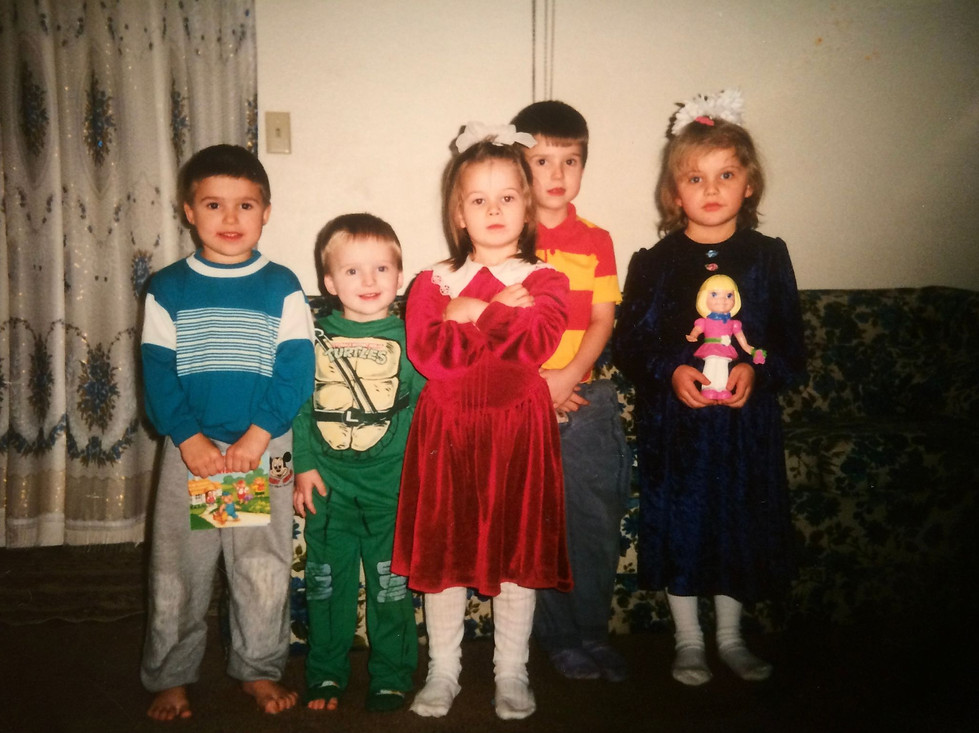
Viktoriya Volkov (center, in red dress) stands with arms crossed among fellow immigrant children, including her sister Anastasiya (right). The stance is more than childhood defiance—it’s a quiet readiness, a foreshadowing of the grit she’ll need to face the unraveling of Portland and the cracks in the promise of the West. Part of the photo archive for Ukrainian Monster: An American Story.

Okay, what's going on here?

PDX7: Photograph by Viktoriya Volkov — from Portland Field Notes and the Ukrainian Monster: An American Story archive — inside Portland Rescue Mission, where her brother Mark once stayed. Behind the glass: Michelangelo’s The Creation of Adam, rebuilt from photos of homeless lives, hanging over the scale where new arrivals weigh in. Beauty and bureaucracy, side by side.

PDX7: Weigh in​ at Portland Rescue Mission


Michelangelo’s The Creation of Adam—


built from photos of homeless lives.

bottom of page